On Being One Inch Tall
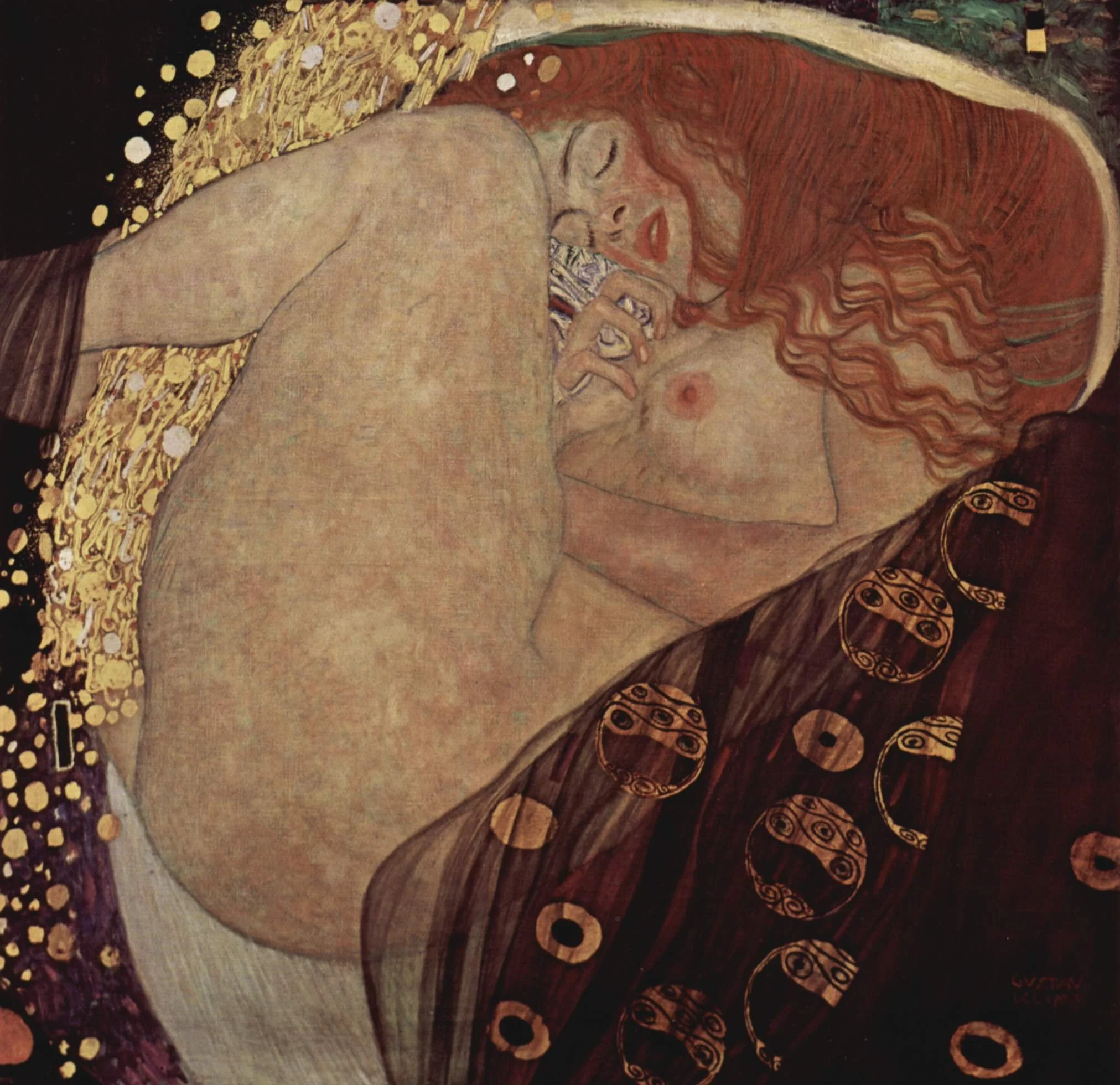
Danaë, Klimt, 1907
In front of Danaë I feel reduced in scale — not diminished exactly, but confronted with a portrait too large, in body and meaning, for me to fully understand.
In the myth, Danaë is locked away by her father in a bronze chamber to prevent a prophecy: that her son will one day overthrow him. But prophecy has little respect for walls. Zeus enters her prison not as a man but as a shower of gold, slipping through the narrowest opening, dissolving the boundary between divine intention and human body.
Danaë curls inward, eyes closed, her body folded into itself as the gold gathers around her. The painting serves to remind how often the moments that define us arrive from scales far larger than our intentions.
Containment
Her father built walls to prevent the future. But the future has always been patient.
There is something deeply human in the instinct to enclose ourselves when we feel vulnerable. We fold inward when the world grows unpredictable. We shrink our lives to manageable spaces — familiar routines, small circles of trust, alcohol, tobacco, relationships both good and bad and always predictable, and rooms where nothing unexpected can enter. We call it safety, but often it is only delay, a quiet hope that if the walls are strong enough the world will pass us by.
But history, like myth, has little patience for containment. The forces that shape us rarely arrive with permission. They simply appear — quietly at first — until we realize the walls were never meant to keep the world out.
The Weight of Gold
Klimt’s gold is heavy. It does not float like sunlight or shimmer like ornament. It presses into the image with a density that makes the divine feel almost physical.
Gold has long represented eternity in art — the unchanging light of heaven in Byzantine icons. Yet here the gold does not remain distant or symbolic. It touches Danaë’s body. It moves toward her, gathering along her legs, her stomach, the center of her being.
This is what makes the painting so unsettling. The divine is not abstract; it is intimate. The myth tells us a god has arrived, but the painting suggests something quieter and more complicated: that the body is capable of receiving things the mind does not yet understand.
And perhaps that is why the moment feels so suspended. Not as conquest, but as contact — as if the body itself knows something the rest of the world has not yet learned how to say.
The Scale of Living
Sometimes we choose to crush such small feelings down, but they remain a force so slight that if you stepped on it with the end of your heel, the quiet resistance of its life would burst outward the moment pressure insisted it should disappear. Sometimes I run my fingers over the grooves of my gold ring and think of how easily gold finds its way through the smallest openings. Through the narrowest opening of my mind though I may feel something entering, and I may become unsettled by it — I know I cannot crush it down. I hope Danaë too felt such bravery as she stared at the night sky in her room.
I often look out at the moon with so much love, not because it rises and sets for me, but because it exists in opposition to the sun. Because then I know the sun will always rise, the birds will still scatter the sky in the morning, and I will breathe again and again and again until I do not. And when that moment comes, all these little observances will cease for me.
The moon will continue its slow arc as it waxes and wanes in and out of view. The birds will continue their scattered migration to the southern hemisphere without witness. And the echo of my existence will live on in the sentences and periods on this page and the next, and maybe it is beautiful or maybe it is haunting. Late at night I think of these things and the only resolution they have is that quiet belief that the moon is high above me — and that I have always been living beneath it.
