The Violence of Succession

Disgusting, vile, uncomfortable, uncanny, evocative, brutal—these are the sensations that meet the viewer before Saturn Devouring His Son by Francisco Goya fully reveals itself. The painting depicts the Greek myth of Cronus, who swallowed his children at birth to prevent a prophecy foretelling his overthrow. One by one, he consumes his future. Only later do the children escape the belly of their father, saved when their mother, Rhea, tricks Cronus into swallowing a stone instead of their youngest son, Zeus. It is Zeus who survives, grows in secrecy, and ultimately cuts his siblings free from Cronus’ body.
Goya painted this image directly onto the walls of his own home as part of what are now called The Black Paintings, works never intended for public display. By this time, Goya had gone deaf, and it was widely believed he was descending into madness. What emerged instead was a vision stripped of spectacle and mercy. The violence of succession appears here not as heroism, but as horror—power clinging to itself so desperately that it devours what comes after it. A father who does not want heirs, only permanence; a ruler who withholds love to prevent succession. This is the ancient logic of Cronus—and the modern logic of men like Logan Roy.
From Olympus to boardrooms, the myth repeats itself. Power fears replacement more than it desires continuity. And in that fear, it consumes its own future.
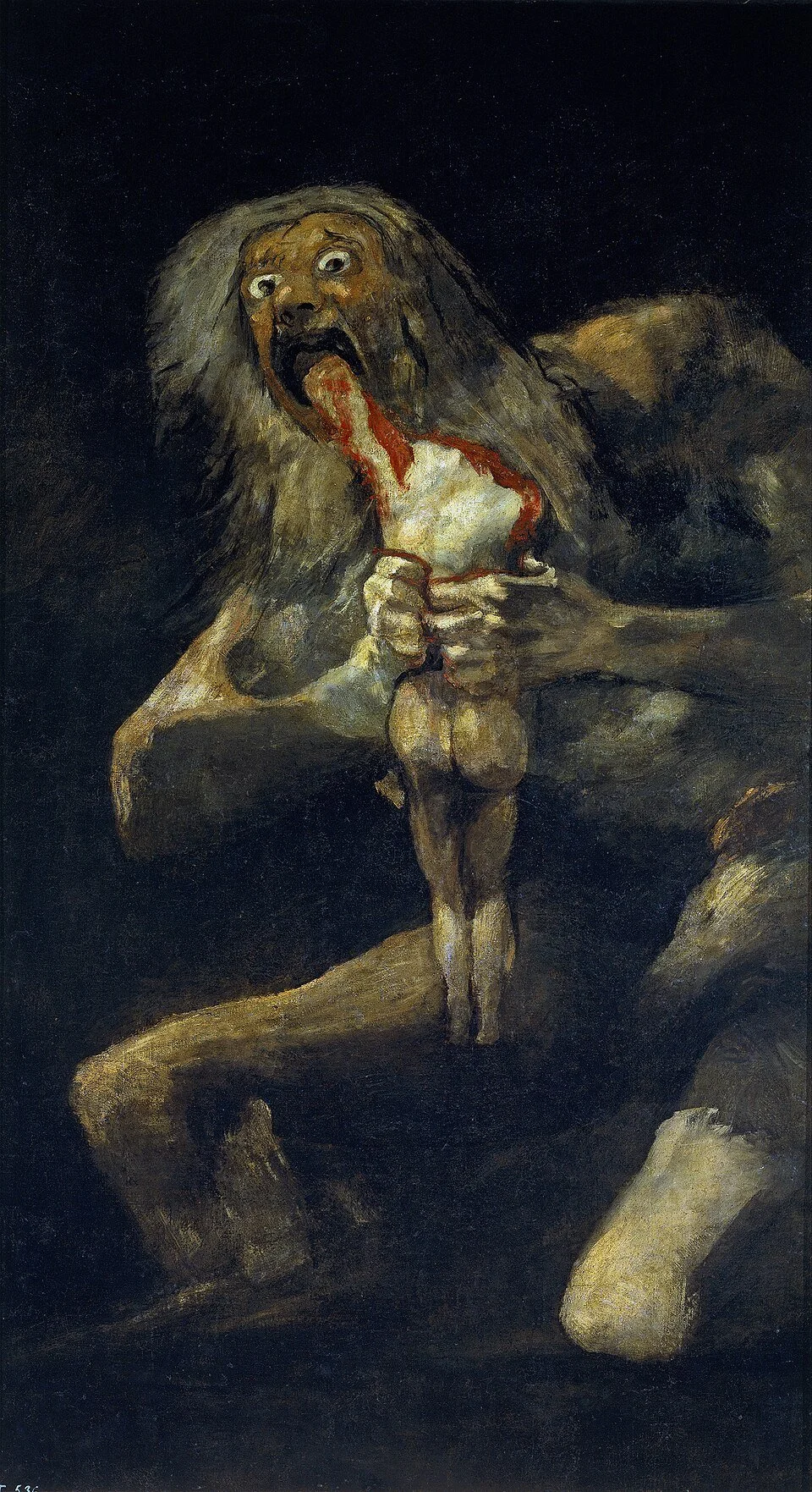
Saturn Devouring His Son, Fransisco Goya, 1820
The Father Who Eats the Future
To inherit power is to threaten the one who holds it. In Succession, Logan Roy humiliates, fractures, and withholds love to prevent his own replacement, confusing control with immortality. Neither father wants heirs; they want permanence, with succession framed not as continuity but as annihilation.
Praise is rationed, affection is transactional, and the children are kept hungry so they never leave. Where Cronus uses teeth, Logan uses language—cutting, diminishing, devouring through words rather than flesh. A dynasty that cannot imagine life without itself teaches its children to disappear. They learn to shrink, to perform, to orbit power without ever touching it. In this way, succession becomes a slow erasure rather than an inheritance, a violence that leaves no visible wounds but hollows its victims all the same.
The Tragedy of Heirs
Kendall, Shiv, and Roman are not incompetent; they are unfinished by design, swallowed into the belly of their father to diminish what they might become. Like Zeus’s siblings, they exist under constant threat—not of death, but of erasure. Their lives are shaped by proximity rather than possession: they rehearse adulthood instead of inhabiting it, mistaking nearness to power for identity itself. What appears as failure is often the result of deliberate containment, a slow digestion meant to keep them dependent, small, and endlessly provisional.
Succession cannot be won by obedience. Zeus does not overthrow his father from inside the stomach; he survives because he is hidden, allowed to grow beyond the reach of Cronus’s fear. He matures outside the dynasty’s field of vision, free from the hunger that would have consumed him. No lineage can be healed by approval, and no system hands over freedom voluntarily. To become something other than what power allows, one must first leave its mouth.
The Cost of Becoming Zeus
Zeus is not a moral victory. He is violent, disloyal, and endlessly repeating the structures he once overthrew. The myth refuses to offer a clean redemption: overthrow does not guarantee transformation, it only proves that the throne itself survives. Power changes hands, but it rarely changes shape. The son who escapes consumption often grows into a ruler fluent in the same language of domination, having learned it as a matter of survival.
This is the tragedy Succession understands with ruthless clarity. The story is not about business or media empires, but about inheritance without nurture—about children raised in the shadow of power yet starved of the conditions required to become whole. Logan Roy, like Cronus, does not fear weakness; he fears continuity. He fears a future in which the world persists without him at its center. And so succession becomes a threat rather than a promise, something to delay, distort, or sabotage entirely.
What the show ultimately reveals is that power terrified of replacement cannot imagine care. It produces heirs who are technically alive yet existentially suspended, circling a throne that will never love them back. In this way, dynasties do not collapse through rebellion alone, but through repetition—through the quiet decision to preserve control at the cost of vitality.
What Succession Ultimately Reveals
Goya’s Saturn Devouring His Son endures not because it is shocking, but because it is honest. It reveals what power looks like when it mistakes succession for extinction, when a father consumes the future in an effort to remain whole. Painted in isolation, on the walls of a private home, the image is stripped of audience and justification—there is no hero here, only hunger.
Cronus’ madness is not ancient; it repeats wherever power refuses to imagine life beyond itself. The violence remains the same: children held close not to be loved, but to be neutralized. And so the painting does not warn us about monsters—it reflects us back to ourselves, asking whether we will continue to confuse permanence with survival, or finally allow what comes after us to live.
